
Flows
A flow answers so you do not have to. Someone comments a word on your post or sends a message, and the flow replies, offers buttons, follows the branch they pick, tags them, and hands the conversation to a person the moment it should be one.
This is one of the two kinds of automation. The overview compares it with triggers, which publish a post instead of answering a person.
What a flow is made of
You draw a flow as steps. Each one does a single thing, and the next step follows from what the contact did.
- Send a message — the direct message the contact receives. Use their name and it is filled in. Up to five files can ride along with it.
- Reply to the comment — a public reply under the post. Write up to five wordings and one is picked per comment, so a busy post does not repeat itself.
- Wait — hold before the next step, from a few seconds up to 23 hours. It stops there because a longer wait would wake up outside the window the platform still lets you answer in.
- Wait for a reply — offer up to three buttons and send each answer down its own path, with a separate path for no answer at all. The flow will wait up to seven days for one.
- Check a condition — branch on a tag, a saved detail, the channel, or whether it is inside business hours. Business hours are 9:00 to 18:00 in your workspace's timezone, and are not configurable yet.
- Tag, untag, save a detail — remember something about the contact and read it back later.
- Hand off — pause the flows on that conversation and leave a note for your team.
- End — stop here.
What starts a flow
One flow answers one message. Two flows never both reply to the same hello.
- A message arrives — every message, or only the ones matching your keywords.
- Someone writes for the first time — the opening line of a new conversation.
- A comment on a post — the "comment a word, get a DM" pattern. Pick any post, or several specific ones. Instagram only: a comment on a Facebook Page never starts a flow.
- A story reply — someone answers your story.
- A referral link — a link that carries a reference you set, so you know where the person came from.
Build one
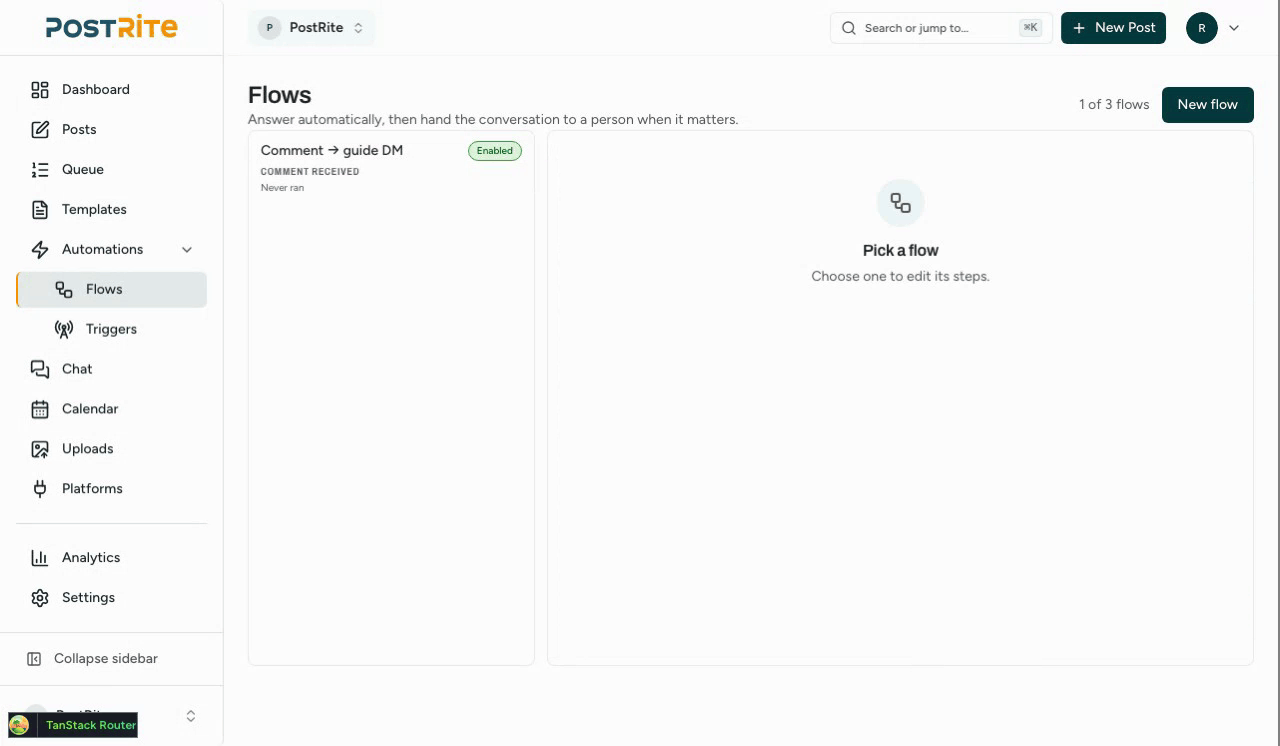
- Open Automations › Flows and pick a ready-made flow — comment a word and get a DM, reply to a keyword, welcome a first message, answer a story reply. Each one arrives with its trigger already set, and Start from blank is there too.
- On the Trigger tab, check what starts it — a ready-made flow has filled this in already — or choose it yourself, add keywords and pick how to match them: contains, exact, or starts with.
- Choose the accounts it answers on. Leave them all unchecked and it answers on every messaging account in the workspace.
- On Steps, draw what happens, then Save. A step that is still missing something says so on the card before you press Save.
- Turn the flow on.
A new flow starts off and nobody hears from it until you turn it on. When you do, PostRite shows you first exactly what it answers and on which accounts — a flow with no keywords replies to every message, which is worth reading before it happens.
Comment a word, get a DM
The flow almost everyone wants, and the one with the most rules attached to it. Start it from a comment, then:
- Choose any post, or several specific ones, picked by thumbnail. The list is your Instagram account's own feed — posts you published somewhere else are in it too, not only the ones PostRite sent.
- Set the keywords that fire it and how to match them.
- Add a Reply to the comment step to answer publicly.
- Then send the direct message — it reaches someone who commented but never wrote to you, which is the only case the platforms allow.
That direct message is a single opening: the platforms allow one private reply per comment, and only for about a week after it was written. After that the normal reply window applies — see Chat.
If you already have a comment flow switched on with no post chosen, it now answers comments on every post on the account — including ones published outside PostRite, which it could not reach before. Open its trigger and pick posts if you want it narrower.
Guardrails
A flow writes to real people, so several limits hold it back by default.
- One flow per message — two flows never both answer the same hello.
- A cooldown and a daily cap, both per contact, so nobody is answered in a loop.
- A step budget, so a menu that loops back on itself still stops.
- A history that records the runs that did nothing, and why — that is the answer to "my flow did not reply".
- Pausing the flows on a conversation stops every flow on it at once.
When a person should take over
Add a Hand off step wherever the flow has done all it usefully can, and it pauses itself on that conversation. Anyone who can edit — an editor, an admin or the owner — can also pause it by hand from the contact panel in Chat, though a viewer does not get that control. No new flow starts while a conversation is paused. Messages a flow sent are labelled in the thread, so whoever takes over can see what was already said.
How many flows you can have
How many flows a workspace can hold depends on your plan — the pricing page lists the number for each. Nothing is deleted if you move to a smaller plan: flows beyond it simply stop answering, and say so in their history, until you upgrade again.